SEO Is a Process, Not an Event ! What UK Business Must Know Before They Start
Updated: Aug 5
Most businesses approach SEO the way they approach advertising. You spend money > something happens > you measure the result. The relationship between investment and outcome is relatively direct and relatively fast.
SEO doesn't work that way. It is a process — one that builds authority, visibility and trust with search engines over months and years, not days and weeks. Understanding that distinction before you invest is the single most important thing you can do to ensure your SEO investment actually delivers.
This article explains:
what SEO actually is
what happens at each stage of the process
what realistic progress looks like
what to watch out for before you spend a penny.
What Is SEO — and Why Does It Take So Long?
Search engine optimisation is the process of making your website more visible to people searching for what you offer. When someone searches "Shopify agency London" or "best running shoes UK" or "accountant near me" — Google decides which websites to show and in what order. SEO is the work that influences where your website appears in that order.
The reason it takes time is rooted in how Google works. Google doesn't simply read your website and immediately decide where it belongs. It discovers your pages, crawls and indexes them, assesses the quality and relevance of your content, observes how users interact with it and gradually builds a picture of your website's authority and trustworthiness over time.
That process has several distinct stages — and understanding them is what separates realistic expectations from frustrating ones.
How Google Actually Evaluates Your Website
Stage 1 — Discovery and Crawling
Before Google can rank your pages it has to find them. Googlebot — Google's web crawler — discovers pages by following links from other pages it already knows about. A new page can take days or weeks to be discovered depending on how frequently Google crawls your website and how well your internal linking structure guides it.
Stage 2 — Indexing
Once a page is crawled Google decides whether to add it to its index — the database of pages it draws from when producing search results. Not every page gets indexed. Pages with thin content, technical issues, duplicate content or no clear purpose may be excluded. Schema markup, clear content structure and proper technical configuration all help Google make a confident indexing decision.
Stage 3 — Assessment and Testing
Once indexed Google begins assessing the page — evaluating the quality and relevance of the content, the authority of the domain it sits on and how well it answers the queries it appears to be targeting. Google then begins testing the page — serving it to a small number of searchers and observing how they respond. Do they click? Do they stay? Do they return to the search results immediately? These signals inform where the page ultimately settles in the rankings.
Stage 4 — Authority Building
Rankings for competitive terms are ultimately determined by authority — and authority is built over time through consistent quality content, external links from other credible websites and a track record of relevance and trustworthiness. This is why a competitor ranking on page one for a competitive term almost certainly hasn't achieved that position recently. They have been building authority — through content, links and time — for months or years.
This is not a flaw in the system. It is the system working exactly as intended — rewarding sustained investment in quality over short-term tactics.
What Realistic SEO Progress Looks Like
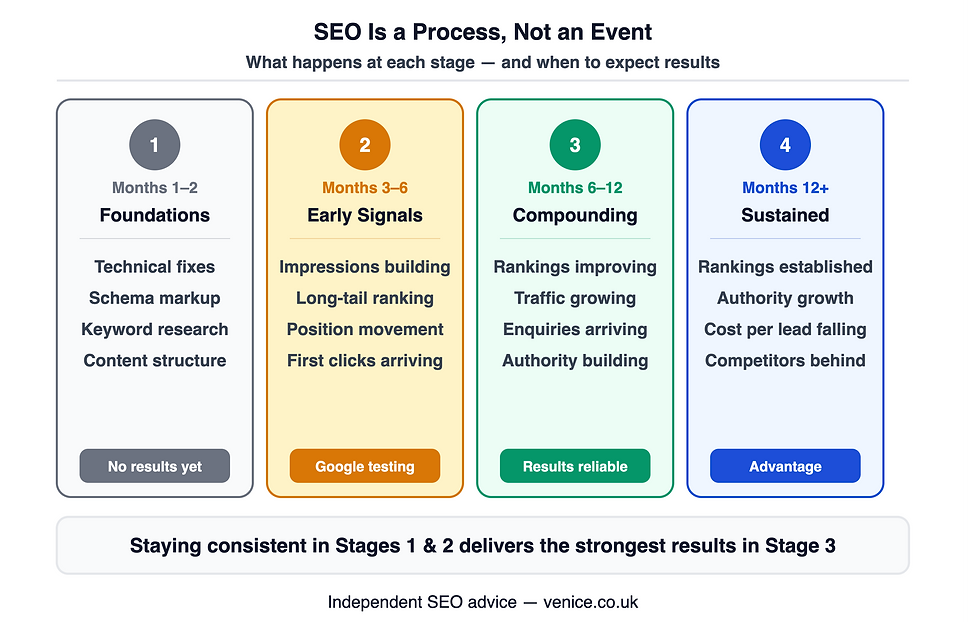
Months 1–2 — Foundations
The first two months of any properly executed SEO programme produce no visible ranking movement. This is normal and expected. The work happening during this period — technical fixes, content structure, keyword research, schema markup, internal linking — is essential groundwork that determines everything that follows. A well-laid foundation produces compounding returns. A poor one produces nothing regardless of how much content is published on top of it.
Months 3–6 — Early Signals
From around month three, the first signals of progress begin to appear. Less competitive queries start ranking. Impressions in Search Console begin to build. Google is testing the content — serving it to small numbers of searchers and observing the response. These are leading indicators that the work is having an effect, even before clicks and traffic become significant.
Months 6–12 — Compounding Results
This is where the process begins to visibly compound. Rankings for target queries improve consistently. Organic traffic starts to grow meaningfully. Enquiries from search begin arriving with increasing regularity. The businesses that stay committed through months one to six almost always see their strongest results here.
12+ Months — Sustained Advantage
Established rankings compound. Traffic continues without ongoing advertising spend. The cost per lead from organic search — which starts high relative to paid advertising — gradually reduces as organic performance strengthens. The authority built over time is not easily eroded by competitors who haven't done the same work.
Your Competitor's Position Tells a Story
One of the most common and least useful conversations in SEO is the competitor comparison. A client sees a competitor ranking on page one for a competitive term and asks why they aren't there too.
The answer is almost always the same — the competitor's position reflects sustained investment over time. They may have been publishing content consistently for two years. They may have accumulated external links from credible sources over three years. They may have fixed their technical foundations long before you started thinking about SEO.
Their current position is not where they started. It is where sustained, consistent investment over time has taken them. The only meaningful response is to start building your own authority — understanding that the timeline to compete is determined by how much ground needs to be covered, not by impatience.
What you can do is identify where the gaps are, which queries are more achievable in the near term and build a strategy that produces early wins while building toward the more competitive targets over time. That is what a properly structured SEO programme looks like.
GEO — The New Layer of Visibility
Traditional search rankings are no longer the only measure of search visibility. AI-powered tools — Google AI Overviews, ChatGPT, Perplexity and others — are increasingly the first point of contact between a searcher and an answer. A business that appears in AI-generated responses reaches potential clients before they ever click a search result.
GEO — Generative Engine Optimisation — is the practice of structuring website content to be cited by these AI tools. It requires well-structured, authoritative content, proper schema markup and clear topical expertise — the same foundations as traditional SEO, applied with an understanding of how AI tools evaluate and cite sources.
For UK businesses investing in SEO in 2026, GEO is not a separate activity. It is an extension of the same process — building content authority and technical structure that makes a website visible wherever people are searching, whether that is on Google, on ChatGPT or anywhere else.
SEO or Paid Advertising — the Budget Trade-off
For businesses that need visibility while SEO builds — particularly those entering a competitive market or launching a new website — a proportion of the marketing budget allocated to paid search advertising makes practical sense. Google Ads provides immediate visibility for the queries SEO is targeting, filling the gap while organic authority develops.
The trade-off is direct and worth understanding clearly. Splitting a budget between SEO and paid advertising means less resource for each. Less SEO budget means slower progress — fewer hours of work, less content, slower authority building and a longer runway to organic results. Less paid budget means less immediate visibility.
Neither is wrong. The right balance depends on the business situation — cash flow, competitive pressure, growth stage and how much runway the business has before it needs organic search to be generating enquiries. Venice assesses this as part of every initial conversation — because the right answer genuinely varies by business.
Watching the Paint Dry — A Note on Checking Data
Checking your Search Console every day will not make your rankings improve faster. It is the SEO equivalent of watching paint dry — the process is happening whether you watch it or not, and watching it more frequently changes nothing about the outcome.
The useful rhythm for reviewing SEO data is monthly at a minimum — looking at impression trends, position movements and which pages are gaining traction. Quarterly reviews are more meaningful still — showing whether the trajectory is positive, which queries are improving and where the next focus should be.
Daily or weekly data is too volatile to be meaningful. A position that was 14.2 on Monday and 18.6 on Thursday and 11.8 on Sunday tells you nothing useful about the underlying trend. The 28-day average tells you something. The 3-month average tells you more.
The discipline of reviewing data at appropriate intervals — rather than constantly — is also the discipline that keeps the client relationship healthy. An impatient daily checker is usually an anxious client. A client who understands the process reviews progress at the right intervals and trusts that consistent work produces consistent results over time.
Warning Signs — What to Watch Out For Before You Spend
"Page One Guaranteed"
No legitimate SEO agency guarantees page one rankings. If an agency makes this promise the question to ask is — page one for what? A guarantee of page one rankings is almost always achieved by targeting a search term so obscure that nobody searches it, or through tactics that produce short-term results followed by a Google penalty that can take years to recover from. Walk away.
Buying Backlinks
External links from credible websites are one of the most important authority signals in SEO. They take time and legitimate effort to acquire. Agencies that offer to build hundreds of links quickly — usually at a suspiciously low price — are almost certainly selling links from low-quality or manufactured sources. Google's algorithm specifically targets unnatural link patterns. The short-term ranking boost is followed by a penalty that can undo years of legitimate work and takes 12–18 months to recover from.
Dramatic Results in Weeks
If an agency produces dramatic ranking improvements within weeks of starting work, ask how. Legitimate SEO — technical fixes, content, proper link building — does not produce overnight results. Dramatic short-term gains are almost always the result of tactics Google will eventually identify and penalise. The subsequent drop is far worse than the original position.
Vague Reporting
A legitimate SEO agency provides clear, regular reporting — showing impressions, clicks, position movements and the work done during each period. If an agency cannot explain what they have done and what effect it has had in plain language, that is a problem worth investigating before it becomes an expensive one.
Very Low Monthly Fees
SEO requires significant time — research, technical work, content, link building, reporting. Meaningful strategic SEO work cannot be delivered at very low monthly fees because the hours simply aren't there. Very low-cost SEO packages are almost always automated tools with minimal human oversight, generic content that does nothing for authority or tactics that create more problems than they solve.
Our View
Venice has been building websites and advising on digital visibility since 1999. The businesses we see generate the strongest long-term returns from SEO are almost always those that approached it as an ongoing investment rather than a one-off project — setting realistic expectations, measuring progress at sensible intervals and staying consistent through the early months when results are not yet visible.
The businesses that struggle are almost always those that expected advertising-speed results from a process that works on a fundamentally different timeline — or those that were sold shortcuts that eventually cost them more than the shortcuts saved.
SEO is a process. It compounds over time. It rewards consistency and patience. And it produces returns — in organic traffic, reduced cost per lead and sustained visibility — that paid advertising alone cannot replicate.
If you would like an independent view on your current search visibility and what a realistic SEO programme might look like for your business, we are happy to start with a conversation.
Key Takeaways
SEO is a process that builds authority over time — not an advertising channel that produces immediate results
Google discovers, crawls, indexes, assesses and tests content before ranking it — a process that takes months not days
Your competitor's page one position reflects sustained investment over time — the only meaningful response is to start building your own authority
GEO — Generative Engine Optimisation — is the practice of structuring content to appear in AI-generated search answers, alongside traditional rankings
Splitting budget between SEO and paid advertising provides immediate visibility while SEO builds — but reduces the pace of progress for both
Check SEO data monthly or quarterly — daily checks are counterproductive and tell you nothing meaningful about the underlying trend
Walk away from any agency promising guaranteed page one rankings, dramatic results in weeks or very low monthly fees — these are reliable warning signs
Venice is an independent web agency based in London, providing SEO services across Shopify, Magento, WordPress and Wix for UK businesses. We give independent advice on search visibility — including when SEO is and isn't the right investment for your current situation.


